Ewe Lamb (female)

Dam: WDR Hazelnut
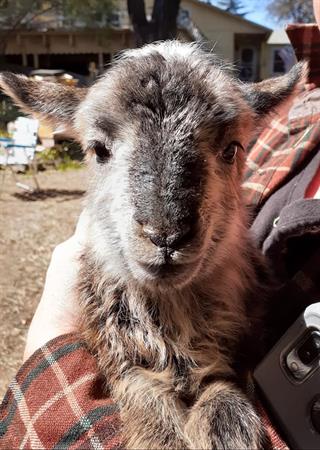
Boromir's first lamb looks just like the female version of him! I generally try to give Navajo-Churros either Spanish or Navajo names to honor their heritage, but this little girl just looked like an Abigail. That name also means "my father rejoices," and she is the first lamb from Boromir.
Sold
Ram Lamb (male)
Dam: SCR Eloise
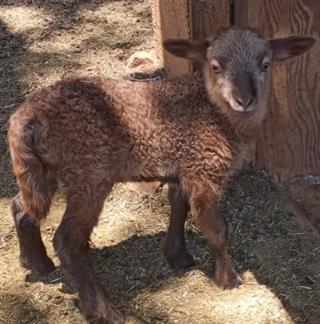
Beautiful, calm boy! Juan Carlos was purchased by Miranda Howard in Michigan (Howard's Knit Knacks) to sire his own flock of Navajo-Churros! I could not be more proud. He is the single two-horned brown ram lamb out of Chief and Eloise. He is the full brother to SHF Poblano "Pablo." Navajo-Churros were first brought to the New World by Spanish conquistadors, making them the first sheep here. Over time, multiple native American tribes raided and traded for them, but the Navajos made the most use of them. They were nearly eradicated by the U.S. government in an attempt to subdue the Navajos, but some surviving sheep hid among the southwestern canyons. Some were also brought west during the Gold Rush. During the Great Depression, one third of all livestock were slaughtered by the U.S. government, nearly eradicating the breed again. It wasn't until the 1970s that some of the sheep scattered in the southwest canyons were developed into the Navajo-Churros we raise today. If you ever wondered why they can be flighty, I believe that is the answer: they're descended from two hundred years of sheep that survived by hiding in canyons.
Sold
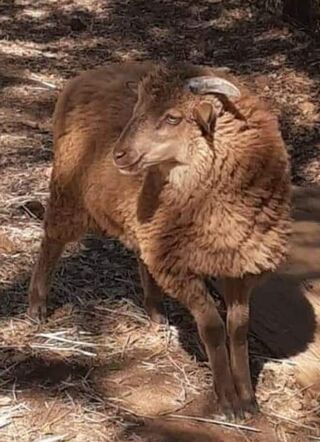
Dam: SCR Eloise
Pablo was born just before dark on July 7th. When I found him, he was still wet from birth, but he was bucking and crow-hopping in circles. That's why he's named after a pepper! Pablo is a single two-horned ram lamb born to Chief and Eloise, who is a stunningly lustrous ewe. He is a gorgeous, rich red-brown, like gingerbread. His eyes are really light and make for a stunning contrast. As with many churros, he is shy and skiddish, but he is also cheerful and energetic. Navajo-Churros were first brought to the New World by Spanish conquistadors, making them the first sheep here. Over time, multiple native American tribes raided and traded for them, but the Navajos made the most use of them. They were nearly eradicated by the U.S. government in an attempt to subdue the Navajos, but some surviving sheep hid among the southwestern canyons. Some were also brought west during the Gold Rush. During the Great Depression, one third of all livestock were slaughtered by the U.S. government, nearly eradicating the breed again. It wasn't until the 1970s that some of the sheep scattered in the southwest canyons were developed into the Navajo-Churros we raise today. If you ever wondered why they can be flighty, I believe that is the answer: they're descended from two hundred years of sheep that survived by hiding in canyons. I will be seeking a home where he will not be eaten, but instead by used to propagate his breed.
Sold
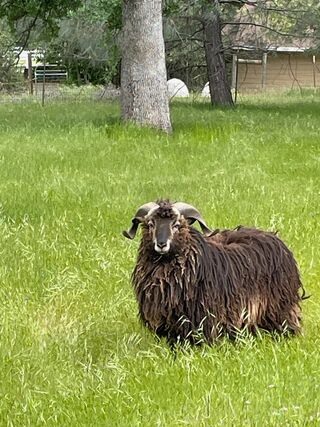
Dam: WDR Hazelnut
Shilah is the most gorgeous variety of colors! I'll be seeking advice about what to actually register him as. He seems to have a predominantly black fleece with tan highlights and some auburn curls. He has tan markings on his face and rump as well. He is sincerely gorgeous, and I hate to part with him at all. But he is related to my other churros, so I will be seeking a home where he will be loved and appreciated and will create more churro lambs. I do not want him to be eaten and go to waste for his breed. He is the two-horned twin to SHF Sierra. Navajo-Churros were first brought to the New World by Spanish conquistadors, making them the first sheep here. Over time, multiple native American tribes raided and traded for them, but the Navajos made the most use of them. They were nearly eradicated by the U.S. government in an attempt to subdue the Navajos, but some surviving sheep hid among the southwestern canyons. Some were also brought west during the Gold Rush. During the Great Depression, one third of all livestock were slaughtered by the U.S. government, nearly eradicating the breed again. It wasn't until the 1970s that some of the sheep scattered in the southwest canyons were developed into the Navajo-Churros we raise today. If you ever wondered why they can be flighty, I believe that is the answer: they're descended from two hundred years of sheep that survived by hiding in canyons. I try to use Navajo and Spanish names to honor their heritage. Shilah is Navajo for "brother," honoring the fact that he is SHF Sierra's twin and SHF Hosanna's younger full brother. Shilah is the most shy out of this year's lambs. He does not like to get too close to people, and most of my photos are of his handsome little butt. Ironically, he does baa the most of everyone at feeding time! He's growing up fast, but he still has that sweet little lamb voice.
Sold
Featured Items